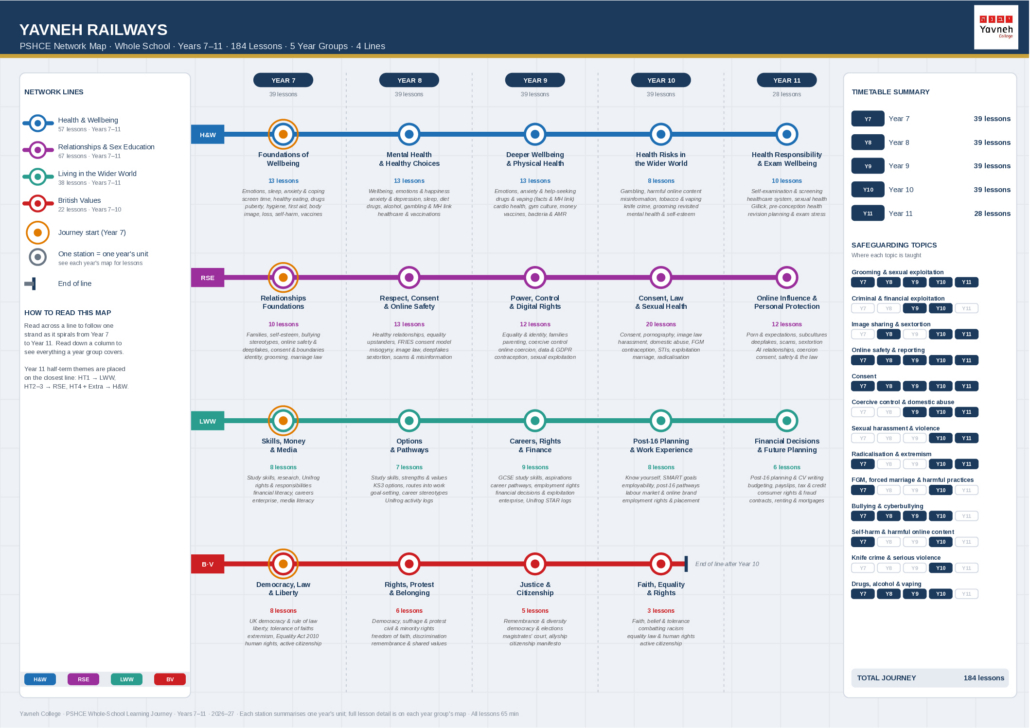
Personal, Social, Health and Economic (PSHE) education is a school subject which helps pupils develop the knowledge, skills and attributes to stay healthy and safe now and prepare for their futures.
This curriculum is based on the three core themes:
- CORE THEME 1: HEALTH AND WELLBEING
- CORE THEME 2: RELATIONSHIPS
- CORE THEME 3: LIVING IN THE WIDER WORLD
Intent
To equip pupils to live healthy, safe, productive, capable, responsible and balanced lives, pupils need the knowledge that will enable them to make informed decisions about their wellbeing, health and relationships. At Yavneh College our intent is to arm students with that knowledge, to enable them to recognise risk and danger in their own and others’ actions and choices and to give them the confidence to make wise decisions. We aim to deliver a curriculum that provides opportunities for pupils to reflect on, explore and clarify their own values and attitudes in relation to the values and attitudes they encounter now and, in the future, and to develop the skills, language and strategies needed to manage life’s challenges as they may encounter them. PSHE aims to equip pupils with the knowledge and skills they need to stay safe and be able to communicate when they do not feel safe. PSHE promotes personal development by helping pupils to build their confidence, self-efficacy, resilience and self-esteem, and helps pupils understand what influences their decisions. It provokes challenging questions about health and wellbeing, relationships and living in the wider world and as such makes a significant contribution to pupils’ SMSC development.
PSHE at Yavneh College sits within our personal development programme, which aims to provide a coherent programme of personal, health, social, citizenship and careers education. The PSHE curriculum is structured and designed to build growing understanding and internalisation of the core substantive knowledge of identity, relationships, a healthy and balanced lifestyle, risk and safety, diversity, equality and rights. PSHCE across the key stages aims to equip pupils to live healthy, safe, productive, capable, responsible and balanced lives, pupils need the knowledge that will enable them to make informed decisions about their wellbeing, health and relationships. Our intent is to arm students with that knowledge, to enable them to recognise risk and danger in their own and others’ actions and choices and to give them the confidence to make wise decisions.
The curriculum is structured to build on existing knowledge from KS2 and throughout their time at Yavneh College, students revisit topics each year, looking at new and increasingly sophisticated scenarios reflective of students’ age and understanding. The PSHE curriculum at Yavneh College is structured to ensure students thoroughly explore and understand the statutory RSE and Health Education topics and in line with the DFE guidance, PSHE includes the non-statutory topics of economic wellbeing and careers. The knowledge acquired within the careers topics contributes to our commitment to fulfilling the eight Gatsby Benchmarks, although much of our CIAG programme sits outside of PSHE as well. Yavneh College subscribes to Unifrog (online careers platform/portal) and students engage with a revisit the range of “tools” on this platform from years 7 to 13.
PSHE is reviewed every year by AHT (Personal Development) and this is based on Quality Assurance of all form tutors which is run by SLT and HOK/HOYs in addition to an annual student survey focusing specifically on the quality of PSHE lessons. Within the survey all students have the opportunity to reflect on the delivery of PHSE lessons over the year and suggest any topics they feel were underrepresented and/or would like to study more about in the future.
Implementation
PSHE is delivered once a week for Key Stage 3 on a Friday and at various points during the week for Key Stage 4. Students are taught PSHE by their tutors in Key Stage 3 and this allows them to work with a member of staff who knows them well and who has daily contact. At Key Stage 4 students are taught by a member of their year group’s tutor team. The curriculum allows for flexibility in order that tutors can address specific concerns that relate to their year group. Many other elements of Personal Development/SMSC are also delivered through daily form time (Monday to Thursday) including Growth Mindset sessions and/or assemblies delivered by Heads of Year and/or guest speakers.
Students work in termly PSHE booklets in weekly lessons in form groups. These are kept in form rooms during the term and then in the head of year office after the end of the term. At the end of each unit students complete a quiz to assess their engagement and understanding of the unit. A record of the results for the quiz are kept on a “PSHE tracker” by Heads of Year. Students who have failed to engage sufficiently with the learning in PSHE demonstrated by their results in the quiz, their engagement in lessons or the completion of tasks in the booklet will be provided with intervention sessions.
Common features of PHSE lessons:
- Interactive and engaging activities
- All lessons begin with a (brief) starter task which students complete independently. This is often in the form of a “do now” or “stop and jot” task
- Recall activities built into lessons to ensure retrieval of prior learning when revisiting topics
- Lessons use a variety of media: music, news articles, documentary footage to allow for a variety of learner experiences
- Regular opportunities for collaborative/paired work and discussion
- Class discussion is used throughout lessons to assess understanding and address misconceptions
- Lessons are taught to the top and scaffolded down
- Questioning and reflective tasks are used to challenge preconceptions and beliefs
- Teacher modelling of appropriate discussion and reflection
- Planned questioning is used to check for understanding and to ensure all students are involved
- Written reflection tasks allow students to internalise their learning and to clarify their thoughts in light of what they have learnt. Written tasks are designed to challenge high achievers and are scaffolded for others
Impact
Ongoing assessment of learning is undertaken each lesson in a variety of ways:
- End of unit quiz (results monitored by form tutor and Head of Year)
- Planned questions
- Verbal responses
- Written responses (reflection tasks)
- Peer/self-marking of activities and tasks
- Questioning to check for misconceptions and then adapting planning to address these
- At Key Stage 5 each term finishes with an “assessment/reflection point” where students must demonstrate their understanding of some of the key topics/issues from the term and offer an opportunity for them to reflect on the sessions/topics they found most interesting and any areas they feel could be further developed.
The impact of our PSHE programme should also be seen across the school in terms of improved wellbeing and mental health of students and a decline in safeguarding concerns and incidents. The impact of PHSE will also be seen through the positive example set by our students both within school and in the wider community through student leadership, extracurricular activities and endeavours, volunteer programmes and charity work. Finally, the impact and success of our programme should be evident through the manner in which our students thrive in their higher education and/or careers once they leave Yavneh College.
Narrative/Rationale
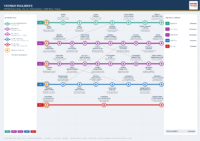
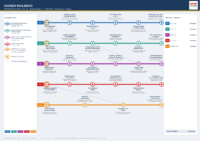
Units are sequences so pupils learn about topics from each of the “core themes” from the PSHCE Association on rotation. Some topics will be completely new while others will revisit and build upon what has been covered in previous years but will reflect the fact that students are a year older and will need to consider these topics in an age-appropriate fashion. RSHE content is in line with the most recent legislation published in the summer of 2025. Relationships and sex education (RSE) and health education – GOV.UK
All PSHE lessons across all year groups begin each term with a reminder for students of who they can talk to if they want/need support or want to talk to an adult about something. There is also an explicit reminder of what to do if they want to raise a concern which might relate to a safeguarding or pastoral matter. This includes reminding students of the various methods at their disposal which they can use including the Kavod Committee, I have a concern form (insight) and JLT. This message is also reinforced across the school with our safeguarding and pastoral posters highlighting the various (relevant) members of staff available to students.
All PSHE programmes across each year group also include a lesson reinforcing the STOPP strategy incorporated into a unit on mental health and self regulation. Students are also encouraged to download the app so this strategy can be used outside of school as well. Finally, all year groups will have some IT skills incorporated into their first PSHE lesson(s) covering the “basics” including creating digital folders for each subject, ensuring work from the previous year is saved into a labelled folder, email protocols and saving/sharing/submitting work.
Year 7
Year 7 begins with supporting students with the transition to secondary school and help equip them with the tools to overcome the various challenges which arise when starting secondary school. In the first instance students will be given a “crash course” in navigating the various ICT skills needed to confidently mange the various new systems and procedures at Yavneh College including use of Teams, accessing homework, creating digital folders, saving/sharing/downloading/submitting work and accessing the school network. Subsequent lesson topics include looking at the changing nature of friendship(s) as well as considering the influences of peer pressure, approval and the nature of self-esteem. As students become more independent (both in/out of school) we then look at (healthy) lifestyle choices (diet, gaming, social media) as students are at an age where they will need to make their own (healthy) lifestyle choices. By the end of the first term, as students are settled into life at Yavneh College, they look at Democratic Government in the UK, learning about our parliamentary system and key features of a democracy. Students also spend the PSHE lesson which is closest to Remembrance Day considering the impact/legacy of both world wars and to remember the sacrifice made by our soldiers for this country.
The second term begins with units on prejudice and bullying. Friendships can change and new ones will usually have been established by this point in the year so it an appropriate time to ensure students how to manage their relationships both in school and the wider community. In conjunction with a series of assemblies which run during this term, students learn about the nature and challenges associated with Neurodiversity. Given that many students in year 7 may not be aware of and/or will not have had any experience of certain disables and learning needs, we feel it is very important for our students understand the importance of tolerance, inclusion and diversity as early as possible in their school life. PSHE lessons continue with a series of Careers lessons to help us fulfil our Gatsby Benchmarks, ensuring students visit and revisit careers every year. Students will experience a “carousel” of Career talks (run by our parents) where they will hear from a range of speakers from different industries and employment sectors. This will be followed up with lessons looking at the skills and qualities needed for different careers and looking at the advantages of Apprenticeships. The final unit in this term revolves around managing puberty. This is placed at this point in the year so students are more than familiar and comfortable with their form tutors.
The final term includes a focus on the risks of alcohol, vaping and tobacco. This is less of a concern at the start of the year but something that may impact some of them as they approach the summer holidays and certainly when it comes to the cycle of Bar and Bat Mitzvah parties in Year 7 and 8. We have also recently added lessons on both consent and the dangers/legality of sending and sharing indecent images to the year 7 curriculum as a reflection on the growing importance of these issues in today’s society. We have placed this at the very end of Year 7 as students will now have (most likely) owned a mobile phone for at least a year and will likely be now engaging in various forms of social media and this is an opportunity to educate students about using their phones in a responsible and safe way. As students are about to spend more time with family over the summer and will likely have spent the year developing and refining their friendship groups, the final topic in Year 7 is families and relationships. This includes looking more closely at the different sorts of relationships within the family unit as well as a lesson exploring how to manage and resolve conflict within different relationships. The final lesson of Year 7 aims to introduce students to the notion of consent in an age appropriate fashion. This is deliberately placed at the very end of the year as students so students have had a year of PSHE lessons and will be able to (better) cope with challenging/adult subjects.
Additional topics covered during Year 7 assemblies over the course of the year include cyber security (session run by Hertfordshire Police), friendships/cliques, resilience, kindness and the power of words. Each Year 7 Form will also be assigned a Senior Prefect who will be with their Form Group for PSHE to support the teacher and act as a source of support for the students as well as role modelling the Yavneh Way.
Year 8
Year 8 begins with looking at personal and online safety. We start with this as this gives students an introduction to the use of online apps that they may have used/been introduced to over the summer holidays and the importance of staying safe on them. This unit also includes a lesson on the dangers and (legal) ramifications of sending/sharing nudes and/or indecent/explicit images. This has been added to the curriculum as students will now have (most likely) owned a mobile phone for at least a year and will likely be now engaging in various forms of social media and this is an opportunity to educate students about using their phones in a responsible and safe way. Students then revisit drug use and peer influence. As students begin to approach their teenage years and will be in the midst of the Bar Mitzvah party cycle it is essential that they have consistent education and guidance around peer pressure and the use of drugs and vaping. We finish the first term considering age, disability and discrimination. As pupils are now more confident in travelling to and from school and are likely to be more independent (especially on a Friday afternoon) this is an opportune time to ensure students understand the importance of being good citizens and respecting others, especially when they are representing the Yavneh community outside of school. We also recognise the importance of tackling student’s preconceived notions about diversity and ensure our students are aware of protected characteristics, as well as valuing respect and inclusivity. These series of lessons concludes with a lesson looking at the nature of “banter” and inappropriate language. During the first term all year 8 students also participate in an interactive First Aid workshop run by Stand Against Violence.
In the second term we start by revisiting careers. This unit of work gives them a greater insight into the different options/pathways available in both the immediate context and thinking longer term with regard to potential career paths. Students then focus on mental health and emotional wellbeing, looking in particular at how students can take care of themselves. As students will likely now be exposed to a wider range of social media platforms, the focus in year 8 is largely about them having a positive impact on social media and how to support other students who may seem unhappy on social media. We also use this unit as an opportunity to address misconceptions around mental health and challenge associated preconceptions and stigmas. The term concludes with the same focus on health and wellbeing but shifts to considering the importance of managing stress. This is done to coincide with the period prior to the end of year 8 exams and with a view that they will be starting their GCSEs in the not-so-distant future.
The final term’s first unit of work revolves around laws and the justice system and also links explicitly to the drugs unit covered earlier in the year which is revisited at this point in time. As students are almost all now entering their teenage years and going through puberty, the topic of healthy relationships is revisited at this point but the focus now shifts towards the issue of diversity in sexual orientation, intimacy, LGBTQ+ and considering the benefits/pressures around delaying sexual activity. During this lesson student will also revisit the topic of consent. The term concludes with an introduction to contraception, the dangers associated with unprotected sex and STIs. The final topics covered here are certainly not an immediate concern for our pupils at the start of the year but will perhaps impact them more as the year progresses. Equally, these lessons are placed prior to the summer holidays to educate pupils accordingly and act as a timely reminder about staying safe if they are in a relationship.
Year 9
The first term welcomes the Year 9 pupils to the academic year with a series of lessons related to their well-being. The first two focus on the potentially challenging transition into Key Stage 4 and the beginning of the path towards GCSEs. Part of these lessons include an ICT skills “refresher” lesson to support student’s with their digital literacy to equip them with (basic) organisational and practical skills including setting up digital folders for each GCSE subject, opening/saving documents, creating PowerPoints and protocol for writing emails. We acknowledge that many pupils may be wary of this transition and the understandable raised levels of pressure to make positive progress. Following on from the focus on transition we revisit the topic of drugs and alcohol use in the context of dealing with peer pressure. Finally, students have a chance to revisit lessons on mental health and mental illness, body image and healthy eating/eating disorders. As students are in the midst of their teenage years education on this issue continues to be of paramount importance and this is why it is revisited at this point. The penultimate unit of the term relate to Remembrance Day to coincide with Remembrance Week (November) and looking at the evolution of the British Army in terms of changing roles of women in the army and the experience of Black British servicemen during the Frist World War. This coincides with a lesson looking at the impact of harmful (racist) language and the role of the “bystander” in situations where there is racist abuse. The final lessons of the term focus back on careers and gives students the chance to register for Unifrog (our online Careers Platform) and create/develop individual profiles and explore the various “Tools” including and Activity and Key Competency log.
The second term students begin with exploring the issues surrounding the use and impact of pornography and then revisiting the issue of keeping safe online but in the context of understanding the consequences and legality of sharing, sending and requesting nude imagery. The final lesson in this unit revisits the nature of consent. This is something students will have been introduced to in PSHE at the end of Key Stage 3 but is something which will continue to be addressed with students in an age appropriate manner throughout Key Stage 4 and 5.
Whilst in the first term students explored the use of drugs in the context of peer pressure, we revisit this topic again but focusing on the impact of the misuse of substances and the social, legal and emotional consequences of addiction. Prior to the final sequence of lessons during this term students learn about how to develop effective revision strategies as they approach their end of year examinations. This session is run by Sixth Form students who are able to share their experiences and realities of revision having completed their GCSEs a year earlier.
The final term concludes by looking at the importance of citizenship and the importance and value of (local) community. This is supplemented by a special workshop led by a local magistrate as part of their “Magistrates in the Community” programme where students participate in a role play highlighting how our legal system works and the different roles within it. This is followed by a lesson on local communities. This comes as a time when students are becoming more socially and racially aware of their own identity and others within the community. As a faith school we are aware that our students will have had a limited exposure to certain elements of British society and we therefore hope to install a sense of pride in the diversity of Britain.
The final term begins with a lesson exploring bank cards and phone contracts. This was something which was added in 2024-25 in response to pupil voice, where expressed an interest in incorporating more lessons into PHSE where students can learn about more “practical” life skills. The term continues with a series on lessons exploring the issues of gender and homophobia, with the aim of giving students a greater understanding of the issues at play here and to give students the confidence to support others. As this is such a growing and important issue in British society, we also invite Keshet UK in to run a session on LGBT+ and attitudes towards gender/sexuality to kick start these lessons. By this point in Year 9 it is likely that students will know young people within the LGBTQ+ community and may well have developed misconceptions and/or preconceptions which need addressing. The final unit of the first term looks at managing conflict at home and within friendships considering both the causes of conflict and evaluating strategies to help resolve this. These lessons are taught at a time when many pupils bodies and hormone levels are continuing to change and their relationships with their families are consequently evolving. These two units have also been placed at the end of Year 9 as students will embark on YCIT at the end of the year, a matter of weeks after these units of lessons. Given that students will be away from home for a long period time (and many for the first time) we want to ensure students recognise the importance of managing conflict within friendships and relationships. Equally, given that students will be in very close quarters to each other over the course of YCIT (sharing rooms, coaches etc) and spending all day with each other, these lessons are a timely opportunity to reinforce the importance the value of tolerance around gender and sexuality.
Year 10
Year 10 begins with a series of lessons related their wellbeing, in particular focusing on information and support around anxiety and the stigmas surrounding mental health. Part of this unit includes exploring strategies to improve resilience and responsibility as well as encouraging students to consider the impact of peer group behaviour and social influences. We begin the year with this topic as many students may have increased levels of anxiety at the start of the year and are entering into a crucial year in their studies. We continue with a focus on both the causes and effects of debt and consider how this can link to gambling and addiction. As well as the obvious importance of students learning about the importance of supporting themselves financially and the risk/dangers of debt, we recognise that students at this age are very likely to have considerable access to online gaming and gambling apps which we know is leading to a rise in debt.
The second term revisits the topic of relationships where students consider the nature of a positive, healthy relationship and then revisit the issues of consent, exploitation and abuse within a relationship. Students then consider how/why relationships might break down and how to navigate (emotionally) through a relationship break up. This series of lessons continues by (re)addressing the importance of online safety with a focus on the dangers of sending/sharing nude images followed by a lesson looking and sexual harassment and safe sex/STIs. This is a timely series of lessons as students are more likely to be entering into (more) serious/intimate relationships at this age and are approaching the legal age of consent. The term continues with a series of lessons revisiting the misuse of substances, and the social, legal and emotional consequences of cases of addiction. We teach these lessons at this period of time as we acknowledge that pupils are (more) likely to possibly succumb to peer pressure and misuse certain substances, such as alcohol and Class B drugs. The final lessons of this term is an opportunity for students to focus on Careers and future choices/pathways. Students will revisit their Unifrog profiles at this points and explore the Subjects Library and Personality Quizzes as well as update their own Activity and Key Competency logs. We have also recently added a lesson on Mortgages and Rent into the Year 10 scheme of learning following feedback from students themselves (pupil voice) who asked us to incorporate more lessons on basic “life skills” into Key Stage 4 PSHE. There are additional related lessons in Year 11 as well.
The final term aims to provide students with an insight into the current political system and current affairs, and how this may impact their everyday lives. These lessons begin with a (re)introduction to the UK political system, the parties involved and how elections work aswell as a lesson looking at Brexit and its implications. We hope that by this age students are becoming more politically aware/active and need to be equipped to understand and engage (better) with the UK political system and current affairs. Following on from these lessons, we explore some of the more problematic elements of our society including racism, Islamophobia and gangs. These are issues which our students will continue to be exposed to as they continue to grow up and are more socially independent. Our final PSHE lessons of the year coincides with the run-up to (significant) end of year examinations, in which pupils will understandably face greater levels of workload and pressure. These are the first “proper” exams students will sit and therefore we focus on building resilience and strategies to support exam preparation/revision.
Following on from their end of year exams students will have one (final) PSHE lesson before embarking on Work Experience. This lesson therefore focuses on preparing students for their work experience placement and exploring “top tips” to ensure students make the most out of this opportunity.
Year 11
The first term welcomes the Year 11 pupils to the academic year with a series of lessons related to maximising their learning potential and how to ensure effective studying which gives them the best productivity to time ratio. Historically students have found the beginning of Year 11 quite stressful as they feel the pressure ‘ramp up’ and therefore giving them practical tools to help with their learning is beneficial. They spend the first lessons reflecting on their progress last year (and in the end of year 10 exams) and making SMART targets to guarantee that they start year 11 on the right foot. This includes reviewing study habits and considering how to prioritise/balance revision. This then links into ‘coping with stress’ in the next unit of lessons as well as revisiting the concept of self-esteem and body image. Students typically begin to feel stress more at this point in the year, and it was a conscious choice to not focus on academic learning, but more on their own mental wellbeing and is placed here before they start their mock exams. Year 11 conclude the term by revisiting tolerance and diversity focusing on the importance of appropriate language and the nature of banter.
The final series of lessons in the first term focuses on ‘Planning for the Future’. Students will shortly begin the Key Stage 5 options process and it is therefore very important that the students understand that there are several different options open to them relating to both post-16 and post-18 pathways. The final lessons allow students to revisit and update their Unifrog profiles (activity/competency logs) and create their own CV (using a universal format through Unifrog). Many students will be approaching the age where they will be looking for part time work and will need to have a basic CV.
In the second term students transition into the next series of lessons which revolve around “employability” where students consider appropriate behaviour in the workplace, encouraging them to recognise that behaviour that is acceptable in school is not necessarily appropriate for the work place. This is followed by a series of lessons looking at both health and safety and rights and responsibilities in the workplace. We finish the term with thinking about finance, budgeting, and bank accounts because this is the last unit students will do before they leave school and the last opportunity for them to acquire “life skills” and the necessary knowledge to live happy and successful lives, without the weight of financial debt.
In the final term, Students focus on exam and revision sessions that lead up to their GCSEs.
Year 12
We begin Year 12 by focusing on the transition to Year 12 from their GCSE studies and how cope with a different workload and environment. As with the beginning of each Key Stage, one of the first PSHE lessons will be an ICT skills “refresher” session. This will focus on ensuring students are able to organise their digital files to set them up for their studies and ensuring students understand email protocols.
Following this, Year 12 learn about the nature of gaslighting and emotional abuse as well as the nature of harassment and stalking. We then shift focus to both mental and physical health to help students take responsibility for their personal development, health, self-care and wellbeing at this crucial and challenging point in their lives. This includes lessons on healthy eating and self-examination for breast and testicular cancer aswell as lessons on the importance of a healthy diet and recognising signs of eating disorders.
Next, we move on to media literacy and digital resilience, where we look at managing online safety and privacy, how to network using social media sites such as LinkedIn, and the potential harms of photoshop and fake news. We finish this unit by exploring extremism and radicalisation. Given how all consuming social media has become for teenagers it is obviously essential that students take time to remember the importance and ramifications of online safety.
The following unit focuses on relationships, values, and consent. We begin by examining different types of relationships, followed by discussions on prejudice and discrimination. This leads into lessons on consent and how police investigate sexual assaults. Students will also attend a special assembly run by JWA on violence against women.
In the final term we then shift our attention to risk, personal safety, and drugs. This includes looking at how to go abroad safely, the importance of first aid, and organised crime. We will also cover alcohol and drugs, with a particular focus on spiking. All these topics are essential for Sixth Form students as they will likely be leading active social lives outside of school and with a view to living away from home in a years time.
In the final half term, we concentrate on the workplace and navigating the world of work. This unit is taught towards the end of Year 12 as students begin to think about end-of-year exams, future career pathways, and “next steps” for life after Yavneh. This unit will also be relevant as students prepare for their work experience week at the very end of Year 12. Additionally, by this point, many students will have part-time or holiday jobs.
PSHE will run for a few weeks after the final half term of Year 12, as students will have their end-of-year exams and work experience week. These lessons will also be dedicated to the UCAS process, where students will begin filling out information for their references and drafting their personal statements. The final PSHE lesson on Year 12 will ensure students are prepared for their work experience placements and take time to set themselves targets and provide “top tips” for making the most out of their forthcoming experience.
All careers and post-18 pathway preparation takes place during weekly form time from the start of September and runs as a separate programme from PSHE.
Year 13
Year 13 begins with an opportunity for students to reflect on their Year 12 work experience placements and on the highs and lows of Year 12 and anticipate the possible challenges they may face in Year 13.
The first half term continues by discussing contraception and parenthood, covering topics such as unintended pregnancy, fertility, as well as readdressing the importance of consent and boundaries within a healthy relationship. As students have now reached the legal age of consent and will potentially be entering into adult and intimate relationships in these years it is important to cover these issues in an age appropriate manner to ensure students are safe and behave responsibly and respectfully within their relationships.
Following this, students will explore employment and responsibilities within the workplace, including professional conduct, the gig economy, bullying in the workplace and trade unions. These are all topics which students are required to study before they leave school and it is felt that Year 13 is the best time for this to take place as they will shortly be entering (or may already be in) the world of work.
Next, we move on to a unit on financial choices, where students will learn about budgeting, payslips, investments, consumer rights, and rental contracts. These topics are obviously all going to be important for Year 13 students over the next few years. We continue with a lesson on the risks around gambling, mindful of the fact that many students in the Sixth Form will likely have been introduced to gambling (especially online).
Students then focus on forming respectful relationships with sessions on building friendships and exploring emotional intimacy. They will also learn about avoiding toxic friendships and revisit issues of consent and sexual harassment in a session delivered by JWA. This is followed by an assembly addressing rape culture, partly delivered by Sixth Form students, which focuses on the experiences and feelings of Yavneh students. The aim is to reiterate that this topic is relevant to our school and the wider community.
The final topic we cover in year 13 is sexual health and self-concept. This includes managing life’s phases, body image, body modifications, the importance of sexual health, and addressing misconceptions related to it. As with previous lessons in Year 13, these topics are very relevant as students will be experiencing greater independence in Year 13 and we want to ensure they are equipped to remain safe and make sensible decisions outside and beyond school as they progress to higher education.
Towards the end of the second term, Streetwise (CST) will run a session on the importance of staying safe, particularly addressing the growing challenges of anti-Semitism faced by students on campus. This session is deliberately placed at the end of the Year 13 PSHE curriculum as students will soon be leaving school and many will be going to live independently at university.
PSHE finishes earlier for Year 13 students as they move towards focusing on preparing for their A level exams and/or BTEC coursework deadlines.
All careers and post-18 pathway preparation, including student finance, takes place during weekly Form Time and runs as a separate programme from PSHE.