
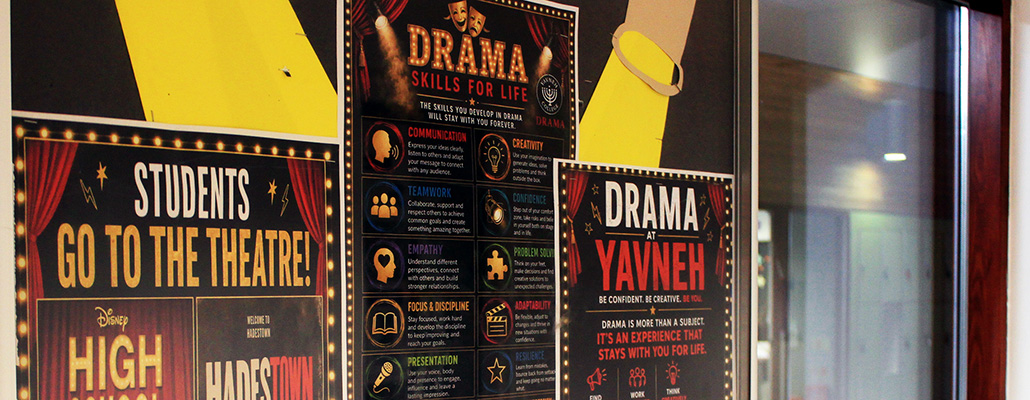
Drama develops confident, creative and thoughtful theatre-makers who understand how performance communicates meaning to an audience. From Year 7, pupils build strong vocal, physical and collaborative skills. By the end of GCSE, they can create, perform, interpret, analyse and evaluate theatre with increasing independence and sophistication.
Reading like a subject specialist
Pupils learn to read a play text as something that will be brought to life on stage, not simply as a story. They explore dialogue, stage directions, character motivation, relationships, subtext, context and dramatic structure, considering how these can influence acting, directing and design choices.
Speaking like a subject specialist
Pupils use precise Drama vocabulary to discuss and justify practical choices. From Year 7 they develop vocabulary including tone, pace, pitch, gesture, posture, proxemics, characterisation and subtext, before progressing to terminology connected to practitioners, performance texts, design and live theatre.
Pupils are expected to explain what choice they have made, why they have made it and what they want the audience to understand or feel.
Thinking like a subject specialist
Drama pupils think about intention, choice and impact. They consider: What does the character want? Why are they behaving in this way? What should the audience understand or feel? Which theatrical choice will communicate this most effectively?
Pupils experiment with ideas, rehearse, respond to feedback and refine their work. From Year 7, they are taught that successful rehearsal means improving and developing a performance rather than simply repeating it.
How we teach it
The curriculum develops progressively from core performance skills towards increasingly independent theatre-making.
Year 7 establishes the foundations of Drama. Pupils develop vocal and physical skills, characterisation and collaborative rehearsal while learning techniques including flashback, cross-cutting, narration, thought-tracking, subtext and monologue. They begin working with play texts and learn how performance choices communicate meaning to an audience. Your Year 7 work explicitly teaches physical skills such as gesture, gait, posture, proxemics and facial expression alongside vocal skills including tone, pitch, pace, pause and emphasis.
Year 8 broadens pupils’ understanding of theatre and different approaches to performance. Pupils explore Stanislavski and Brecht, study verbatim theatre, investigate character and interpretation through Shakespearean villains, practically explore a play text, and develop their ability to analyse and evaluate live theatre. They begin to recognise how different theatre-makers can approach the same dramatic material in very different ways.
Year 9 provides the bridge to GCSE Drama. Pupils undertake more sustained devising, study theatre practitioners, develop written analysis, explore a play text and develop their ability to analyse and evaluate live theatre. They increasingly explain and justify their own theatrical choices as preparation for the demands of the Edexcel course.
In Years 10 and 11, pupils complete the three Edexcel GCSE components: Devising, Performance from Text and Theatre Makers in Practice. They create and evaluate original theatre, interpret and perform extracts from a published performance text, study their prescribed set text practically and prepare to analyse and evaluate live theatre.
How we check understanding
Understanding is checked continually through questioning, practical rehearsal, performance, quizzes and written responses. Pupils are expected not only to demonstrate a skill but to explain why they have made a theatrical choice and its intended impact.
Teacher and peer feedback is used to identify what needs to be revisited or improved. Pupils regularly refine practical work and improve written work following feedback.
How we support every learner
Drama skills and terminology are explicitly taught, modelled and revisited. Practical tasks are broken into clear stages using examples, defined roles, key vocabulary, modelling and structured rehearsal guidance.
This enables pupils with SEND or EAL to access the same ambitious curriculum, with scaffolding gradually reduced as confidence develops. Pupils who are ready for greater challenge are expected to make increasingly subtle, detailed and original theatrical choices.
What great looks like
By the end of Year 7, pupils can create a convincing character using a purposeful and controlled range of vocal and physical skills. Your existing mastery criteria already emphasise vocal variation, purposeful gesture, posture and movement, pauses, varied expressions and choices linked to character.
By the end of Year 8, pupils can apply contrasting theatrical approaches, interpret a scripted character, explain the purpose of different performance styles and evaluate the effectiveness of choices made in live theatre.
By GCSE, pupils can create and develop original theatre, apply theatrical skills to realise clear intentions in performance, demonstrate knowledge and understanding of how theatre is developed and performed, and analyse and evaluate their own work and the work of others. These are the four Edexcel assessment objectives.
Help at home by…
- Encouraging pupils to learn lines and rehearse regularly, rather than immediately before a performance.
- Asking them what their character wants and how their vocal and physical choices communicate this.
- Encouraging the use of Drama vocabulary when discussing theatre, television or film.
- Supporting the completion of written Drama homework and improvements following teacher feedback.
- Where possible, watching live or recorded theatre and discussing acting, directing and design choices, not simply the storyline.